Israel Has the Right to Defend Its Citizens

Updated: Aug 25

Opinion & Analysis
By Yousef Ibrahim Barjas Alta'any
I think one of the most critical things that's not talked about when you're talking about the Israel–Hamas conflict is Israel's right to protect its people. There are many different views on the war, on the actions of the Israeli government and on the humanitarian impact of the war. But in my opinion, these discussions need not to be oblivious of the security challenges that Israel and its people still face.
Supporting Israel's right to defend itself doesn't necessarily mean supporting every military action, taken on its own merits. I strongly believe that the responsibility for the acts of all countries is still intact, and they should respect international law. I do not believe that one cannot criticize Israel without taking a step to either ignore, or deny, Israel's right to defend its people from attack. Throughout its history, Israel has been the subject of wars, terrorism, rocket attacks, shootings and violence in general.
The events of 7 October again showed that these threats are not things of the past. Israelis lost their lives, were injured and kidnapped, and awakened the world to the reality of Israeli security issues. I think this poses an important question: How can Israel expect to protect its citizens when armed groups that have already attacked Israel can still have weapons and military capabilities?
Hamas and the ongoing security danger
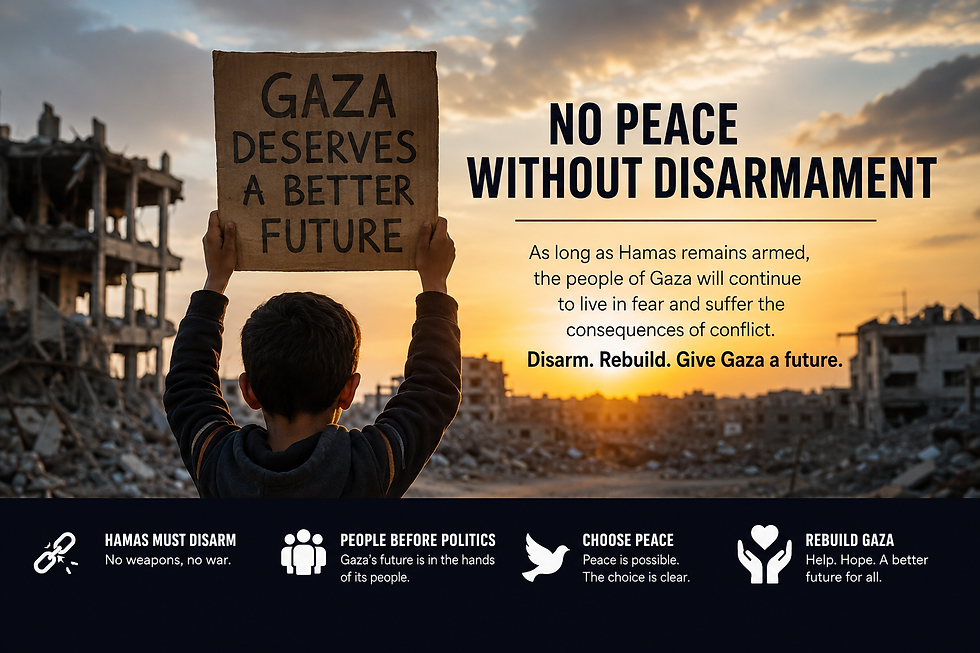
In my opinion, this is one of the reasons which Hamas disarmament is still so significant. Political pledges or pledges made at the negotiating table are not enough to take away weapons or to make the likelihood of future attacks zero. As long as Hamas keeps weapons, military infrastructure and is capable of building its military strength, I think that Israel has a right to be concerned about the security of its citizens. Israel's security argument for continuing with military operations and for insisting any process of disarmament be real and verifiable is the ongoing threat from Hamas and other armed attacks. I don't think that Israel can just be expected to wait for promises.
In order to be taken seriously if Hamas has a serious desire to abandon armed conflict, it needs to show it in practice, not just in theory. That is why, in my opinion, any future accord related to the disarmament of Hamas should have a procedure that is clearly defined and independently verifiable. There should be a mechanism to determine if weapons were actually handed over, if military infrastructure was broken down and if armed groups are still able to threaten Israeli civilians. Otherwise I think Israel wouldn't have been able to have any confidence that it wouldn't happen again.
Israel's Right to Protect Its Citizens
I think all nations have the duty to safeguard the citizens from attacks. Israel should not be singled out. Israel's families should be able to live without living in fear of another attack. Children should not live in a world where they are at risk of rockets, shootings, kidnappings or other forms of violence being a part of their lives. Not for me, however, identifying this translates to neglecting the suffering of Palestinian civilians. Palestinian families are entitled to safety, dignity and the chance to live in peace too.
I do not think that the security of Israelis and the recognition of the suffering of Palestinians are contradictory.
The long-term goal is for both Israelis and Palestinians to have a future in which they live in peace. But I don't think that peace can be negotiated without taking into account the presence of armed groups that still pose a threat to Israelis. Security is a pre-requisite for peace, and the causes and sources of continued violence must be addressed.
Peace Cannot Be Built on Promises Alone
One of the greatest problems that any future peace accord is faced with is lack of trust.
Israel must not only hear the Arabs' intention to disarm, but also their willingness to do so. I think it is important for Israel to understand that the threat has been really lifted. That's why promises are insufficient.
So, if Hamas truly wants to build a "new future" for Gaza, its pledge to disarmament ought to be fulfilled in due course. Weapons should be taken out. Military facilities need to be removed. There should also be an independent process that can ensure these commitments have been delivered.
I believe that the ability to do so is not only key to Israel's security, but also to the future of Palestinians in Gaza.
The people of Gaza deserve to live a life of reconstruction, education, employment and opportunity and not another generation of war.
But I do not see how this future can be realised when the armed organizations are still able to go back to violence.
A Future of Peace Requires Security
I am pro Israel and I believe in the right of Israel to exist, and to protect its citizens. Meanwhile, I think the Palestinians merit a future not defined by war and by repeated warfare.
I don't think that these roles are mutually exclusive for me. I think that permanent peace in the Middle East can be achieved by acknowledging the legitimate security concerns of the Israelis, and at the same time improving opportunities and a stable future for Palestinians. There is a major conflict over whether Israel can afford to pursue peace and security.
A real peace must offer both. But, I do not think that is going to happen with just political statements and promises during negotiations. It will take real will to put an end to violence and to eliminate the capacity of armed groups to terrorise civilians.
For me, there's one point that's evident:
Israel has the right to defend its citizens.
The task at hand is how to bring a reality into existence, in which Israelis don't have to live in constant fear of another attack and Palestinians don't have to endure another generation of war. I believe that this future will need security and accountability, reject violence and be ready to go beyond the cycle of violence.
Then peace will have a chance to be more than a respite.
Disclaimer
This article reflects the personal opinions and analysis of the author based on publicly available information at the time of writing. The views expressed are solely those of the author and are intended to contribute to informed public discussion. The author encourages readers to examine multiple sources and perspectives when considering complex political, historical, and international issues.
Copyright
© 2026 Yousef Ibrahim Barjas Alta'any. All rights reserved.
This article is the original work and intellectual property of the author. No part of this publication may be reproduced, distributed, translated, republished, stored in a retrieval system, or transmitted in any form or by any means, whether electronic, mechanical, or otherwise, without the prior written permission of the author, except for brief quotations used for commentary, criticism, news reporting, academic research, or review, as permitted under applicable copyright law.
Opinion & Analysis
By Yousef Ibrahim Barjas Alta'any (Yousef Altaany)